Intro Generative AI
This session introduces Artificial Intelligence, covering its background, historical context, and the fundamentals of AI development. It also provides an overview of prompt engineering techniques for generating text and images, setting the foundation for understanding AI’s capabilities and applications.
Listen
Introduction to Generative AI
Transcript
| Speaker | Text |
|---|---|
| Alex | Welcome to the Deep Dive. Today we’re diving into the world of generative AI and I have to say, even just skimming through our source material, a college syllabus from Georgia State for course kicking off January 13, 2025. My mind is already buzzing. Imagine a computer crafting poems, composing symphonies, or even designing a new product. That’s the power of generative AI and it’s already shaking up the world in some pretty wild ways. |
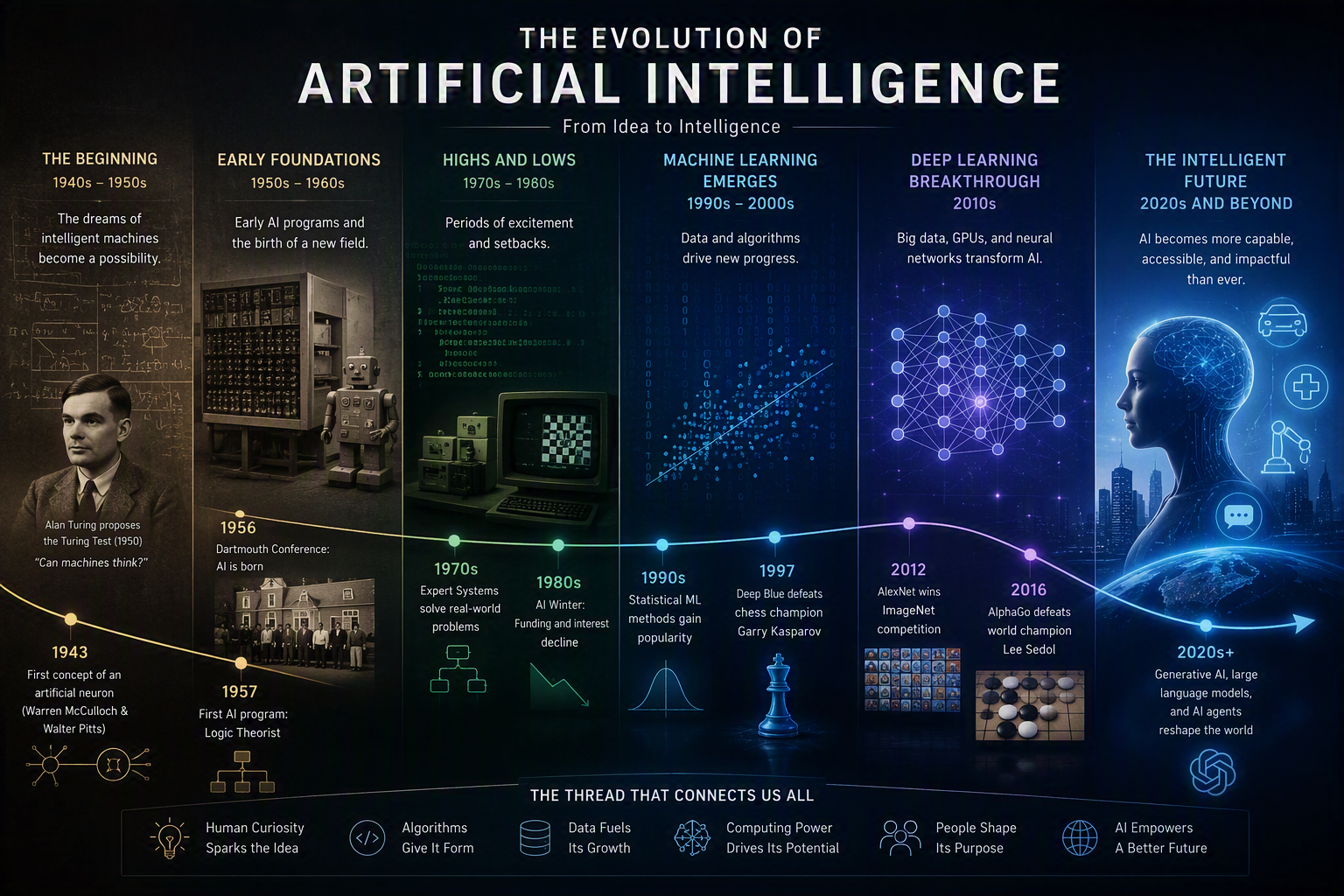
| Sam | It really is changing the game. We’ve moved way beyond AI just processing information. Generate AI is all about creating, and it all stems from this fascinating evolution of what we even consider AI. Back in 1990, the focus was on machines mimicking human intelligence, but by 1993, the definition shifted to simply automating intelligent behavior. |
| Alex | So instead of trying to replicate our brains, we started focusing on getting results regardless of how the machine achieved them. I guess that opened up a lot of new possibilities. |
| Sam | Exactly. And to understand where generative AI is going, it helps to see where it came from. Think back to 1957 with the text-based game Zork. It might seem basic now, but players typing commands and getting unique responses, that was a huge leap in AI understanding and responding to human language. |
| Alex | That’s fascinating. So even back then we were starting to see the seeds of AI interacting with us in a more natural way. Absolutely. |
| Sam | Then in 1971, Terry Winograd’s Blocks World showed AI actually solving problems and moving objects in a virtual environment. It’s like giving a computer a set of building blocks and watching it figure out how to stack them based on your instructions. |
| Alex | So, it’s not just understanding language, but actually taking action based on that understanding. Pretty impressive for the early 1970s. |
| Sam | And then in 1983, IBM’s Watson blew everyone’s minds by winning on Jeopardy. Understanding complex questions, sifting through mountains of data, and spitting out accurate answers, that was a game changer. |
| Alex | It really showed the |
| Sam | world |
| Alex | what AI could |
| Sam | do, |
| Alex | and I bet it got a lot of people thinking about the possibilities. But let’s bring it back to generative AI. How does all of this connect to AI actually creating things? |
| Sam | These milestones paved the way for the sophisticated generative AI we have today. Zork demonstrated AI’s early grasp of language. Blocks World showcased its ability to solve problems and manipulate virtual objects, and Watson highlighted its prowess in processing information and retrieving knowledge. All these elements are crucial for generative AI to function. |
| Alex | So it’s like all these seemingly separate advancements were actually pieces of a puzzle. That eventually came together to create generative AI. |
| Sam | Precisely. And when we talk about AI, it’s important to distinguish between the different types we’re dealing with ANI, AGI, and ASI. ANI, or artificial narrow intelligence, is what we see all around us today. Your voice assistant, personalized recommendations online, spam filters. They’re all great at specific tasks, but pretty limited outside of those. |
| Alex | So ANI is like a specialist, whereas AGI or artificial general intelligence would be more like a generalist, right? Capable of learning and solving problems across a wide range of tasks like a human can. |
| Sam | Exactly. AGI is still largely hypothetical though. We haven’t cracked the code of creating machines with that level of cognitive flexibility and adaptability. Then there’s ASI, artificial superintelligence, which takes things even further. Imagine AI surpassing human intelligence in every way that raises a whole host of exciting and potentially unsettling questions. |
| Alex | It sounds like something straight out of science fiction, but for now, let’s focus on what’s driving the current generative AI explosion. The syllabus mentions deep learning. Can you break that down for us? |
| Sam | Deep learning is a powerful type of machine learning inspired by the human brain. It involves training artificial neural networks, these complex webs of interconnected nodes, to learn from massive amounts of data. Think of it like this. When a child learns to recognize different animals, their brain strengthens connections between neurons that represent those animals’ features. Deep learning works similarly, but on a much grander scale. |
| Alex | So these neural networks are basically the building blocks of deep learning, and they allow AI systems to identify patterns, make predictions. And even create new content, right? |
| Sam | You got it. And the history of neural networks is fascinating. Believe it or not, the concept of back propagation, a key algorithm in training them. Was described as early as 1974. |
| Alex | Wow, that’s way earlier than I would have guessed. So why are we seeing this boom in generative AI applications now? What’s changed? |
| Sam | Several factors converged. First, the internet and digitization have given us access to mountains of data. Second, computing power has skyrocketed, making it possible to train these complex models. And third, we’ve had major breakthroughs in algorithms like the development of transformer networks. |
| Alex | Transformers. That sounds pretty sci-fi too. |
| Sam | It does. Transformers are a type of neural network architecture that has revolutionized natural language processing, which is crucial for generative AI. |
| Alex | Speaking of natural language processing, this syllabus mentions large language models or LLMs. They seem to be everywhere these days. Can you give us the rundown? |
| Sam | LLMs are a powerful type of AI trained specifically on language. They can understand and generate human-like text based on massive data sets of text and code they’ve been trained on. Think of chatbots that can hold remarkably realistic conversations or AI tools that can whip up different kinds of creative content. |
| Alex | It’s incredible to think AI can now write poems, scripts, even code. The syllabus mentions a few big names in LLMs Paul M, Lamb DA, GPT, and Bloom. Are they all basically doing the same thing? |
| Sam | They all fall under the umbrella of LLMs, but each has its strengths and is being applied to different tasks. |
| Alex | OK, so we’ve got these powerful AI wordsmiths at our fingertips, but how do we guide them? How do we tell them what we want them to create? |
| Sam | That’s where prompt engineering comes in. It’s the art of crafting effective inputs or prompts to steer the LLM toward the desired output. Think of it like giving Clear instructions to an apprentice. If you want an LLM to write a Shakespearean sonnet, your prompt needs to be specific about the style, tone, and subject matter. |
| Alex | So it’s not just about giving the LLM a topic. It’s about setting the scene and giving it the right cues to create what you’re looking for. |
| Sam | Exactly. The prompt is the key to unlocking the LLM’s creative potential and guiding it toward a specific goal. |
| Alex | This is all fascinating, but how do these LLMs move beyond just generating text? How do they actually do things in the world? |
| Sam | That’s where AI agents enter the picture. Think of them as sophisticated programs that use LLMs as their brains, enabling them to interact with the world and complete tasks. They can understand instructions, execute multi-step processes, and even learn and adapt to new challenges. |
| Alex | So it’s like taking the language understanding and Generation K. Abilities of an LLM and adding a layer of action on top of that. You |
| Sam | got it. It’s like giving the LLM a set of hands and feet so it can interact with its environment. Think of a personal assistant that not only manages your schedule, but also learns your preferences and anticipates your needs. That’s the kind of potential we’re talking about. |
| Alex | That’s incredible. But how do we get from a powerful LLM. To a sophisticated AI agent that can actually do all that. It seems like there’s a lot more going on under the hood. |
| Sam | There definitely is, and that’s what we’ll pick up in part two of our deep dive, picking up where we left off. Let’s take a closer look at how those AI agents are actually built. It’s pretty mind blowing how they go from a text generating LLM to something that can interact with the world. |
| Alex | I all ears, we were talking about how AI agents are like giving in LLM hands and feet. But I’m curious how that actually works in practice. What are the building blocks of these sophisticated agents? |
| Sam | Well, one crucial aspect is how these LLMs actually process language. It’s not as simple as just understanding individual words. It’s about breaking down text into smaller units called tokens. |
| Alex | Tokens. So it’s like taking a sentence and splitting it into words, punctuation marks, and maybe even parts of words. |
| Sam | You got it. The level of granularity can vary depending on the model, but essentially each token gets a unique ID that the LLM uses for processing. |
| Alex | That makes sense. The text isn’t just a bag of words, right? The order matters. How does the LLM keep track of that sequence when dealing with all these individual tokens? |
| Sam | That’s where positional encoding comes in. It’s a clever way of adding information about the order of those tokens, so the model doesn’t lose the sentence structure and meaning. Imagine reading a sentence where the words were jumbled up. It wouldn’t make much sense. |
| Alex | Yeah, it’d be like trying to follow a recipe where the steps were all out of order, a recipe for disaster. So positional encoding helps the LLM maintain the logical flow of information, which is crucial for understanding and generating coherent text. |
| Sam | Exactly. And once the text is tokenized and positionally encoded, the LLM can start doing its magic. Which boils down to predicting the next token in a sequence. It’s like a supercharged autocomplete, always trying to guess what comes next based on the preceding text. So |
| Alex | given a starting prompt, the LLM predicts the most likely word to follow, then the next and the next, building a whole chain of text based on those predictions. |
| Sam | That’s the basic idea. But the way the LLM chooses the next token can be influenced by different sampling methods, which control how deterministic or random the output is. |
| Alex | So if I understand correctly, some sampling methods might stick to the most probable words, leading to predictable text, while others might introduce some randomness, making the output more creative or unexpected. |
| Sam | Precisely. And there are a variety of methods, each with its own strengths and weaknesses. AGMAX selection always chooses the token with the highest probability, which is simple, but can lead to repetitive text. |
| Alex | So what are some other methods that could make the output more interesting? And less predictable. |
| Sam | Well, there’s temperature sampling, which allows you to control the randomness by scaling the probabilities. Higher temperatures lead to more surprising results, while lower temperatures stick closer to the most likely choices. It’s like turning up the dial on the LLM’s imagination. |
| Alex | That’s a great analogy. I can see how that would be useful for different types of creative applications. But are there any methods that try to keep things a bit more controlled, ensuring that the output is still coherent? |
| Sam | Absolutely. Top key sampling limits the choices to the top K, most likely tokens, making the selection more manageable. And Tapa nuclear sampling selects from the smallest set of tokens that meet a certain probability threshold, which can dynamically adjust based on the context. |
| Alex | OK, so there are a lot of ways to fine tune the LLM’s output and control how it generates text, but I’m curious, how does it go from predicting one word at a time. To generating a whole paragraph, a poem, or even a code script. |
| Sam | That’s where the model’s architecture and training come in. Powerful LLMs like GPT use a transformer architecture which allows them to process information in parallel and capture long range dependencies in text. |
| Alex | So instead of processing words one by one, it can consider the entire sentence or even paragraphs simultaneously. |
| Sam | Exactly. It’s like being able to see the whole forest instead of just individual trees. This ability to understand the bigger picture is crucial for generating text that’s both coherent and contextually relevant. |
| Alex | That makes sense. But how does the LLM learn all of this in the first place? How does it develop this remarkable ability to predict the next word and generate such diverse types of text? |
| Sam | It all starts with pre-training. LLMs are trained on massive amounts of text data, often billions of words, absorbing patterns, grammar, and even stylistic nuances. It’s like immersing a child in a world of books and letting them naturally soak up language. |
| Alex | So it’s all about exposure and repetition. The more text the LLM sees. The better it becomes at understanding and generating language, |
| Sam | precisely. And the quality and diversity of that training data are key. If you train an LLM on scientific papers, it’s going to generate text that sounds like a scientific paper. Train it on poetry, and it’ll produce something more lyrical. |
| Alex | So the training data shapes the LM’s voice and its ability to generate different types of text. That’s fascinating. But we were talking about AI agents earlier. How do we go from a general purpose language model to a specialized tool that can translate languages, write different kinds of creative content, or even interact with the world? |
| Sam | That’s where fine tuning and techniques like transfer learning come in. Fine tuning allows us to take a pre-trained LLM. And further train it on a smaller task-specific data set, adapting it to a particular application. |
| Alex | So if we want an LLM to be a master translator, we fine tune it on a data set of parallel texts in different languages. Exactly. |
| Sam | Or if we want it to write code, we fine tune it on a data set of code. Fine tuning allows us to leverage the LLM’s vast general knowledge and then specialize it for a particular domain or task. |
| Alex | It’s like taking a general purpose AI Swiss Army knife. And sharpening one of its blades for a specific purpose. I like that analogy. It’s |
| Sam | a |
| Alex | good |
| Sam | one. And transfer learning takes this concept a step further. It allows us to take the knowledge learned by a model on one task and apply it to a different but related task. |
| Alex | So it’s like teaching a dog to fetch a ball and then realizing it can also learn to fetch a frisbee, because the underlying concepts are similar. That’s |
| Sam | a great way to put it. Transfer learning is especially useful when we have limited data for the new task. We can start with a model that’s already learned a lot of relevant information and fine tune it, giving it a head start. |
| Alex | So we’re essentially building on the model’s existing knowledge. Instead of starting from scratch, it sounds very efficient. |
| Sam | It is, and this approach has become a cornerstone of AI development, particularly in natural language processing and computer vision. |
| Alex | OK, so fine tuning and transfer learning help us specialize these LLMs and adapt them to a wide range of applications. But I’m still curious about how we go from a powerful language model to a fully fledged AI agent that can interact with the world. Can you walk us through that process? |
| Sam | One fascinating technique that bridges this gap is called retrieval augmented generation, or RG for short. |
| Alex | RG. That’s a new one. What’s so special about it? |
| Sam | AED takes LLMs to the next level by giving them access to external knowledge sources, making the responses more relevant and up to date. Think of it like connecting the LLM to a massive library. |
| Alex | So instead of relying solely on the information it was initially trained on, the LLM can now tap into a vast pool of external knowledge. |
| Sam | Exactly. It involves extracting queries from the input prompts, searching external sources like databases or the internet. And then incorporating that information into the LLM’s responses. |
| Alex | That sounds incredibly powerful. It’s like giving the LLM the ability to research and fact check its responses in real time. |
| Sam | That’s a great way to think about it. And this ability to access and integrate external knowledge is crucial for building AI agents that can truly understand and interact with the world in a meaningful way. |
| Alex | This is really opening my eyes to the complexity and potential of AI agents. We’ve covered so much ground already, but I’m eager to hear more about the specific ways these agents are being used and what the future holds for them. Where do we go from here? |
| Sam | Well, now that we have a solid understanding of the foundations, let’s shift our focus to some of the more tangible applications and implications of generative AI in our world today. |
| Alex | It’s amazing to think how far generative AI has come from those early milestones to the sophisticated AI agents we’re seeing today. But as with any powerful technology, there were a lot of questions about its impact on our world. |
| Sam | Absolutely. Generative AI is already being used in a wide range of fields, and it’s only going to become more prevalent in the years to come. |
| Alex | So where are we seeing generative AI make the biggest waves right now? What are some of the most exciting applications? |
| Sam | One area where it’s making a huge impact is content creation. Imagine marketing teams generating highly targeted ad copy with just a few clicks, or journalists using AI to help them sift through mountains of data and write news stories. Generative AI can even create realistic images and videos, which opens up a whole world of possibilities for entertainment and advertising. |
| Alex | It sounds like it could be a game changer for creative industries. But I imagine there are concerns about AI replacing human jobs too. What are your thoughts on that? |
| Sam | That’s a valid concern. Like any technological advancement, generative AI will likely lead to some job displacement, but I see it as more of a collaboration than a replacement. AI can handle repetitive or tedious tasks, freeing up humans to focus on higher level creative work. |
| Alex | So it’s about finding the right balance. Using AI to augment human capabilities rather than completely replacing them. I can see how that could lead to some exciting new forms of creativity and innovation. |
| Sam | Exactly. Think of musicians using AI to generate new melodies or artists collaborating with AI to create unique visual pieces. Generative AI can be a powerful tool for pushing the boundaries of what’s possible in the creative realm. |
| Alex | This syllabus also mentions generative AI’s potential in fields like drug discovery and material science. That seems like a pretty big leap from writing poems or composing music. |
| Sam | It might seem like a leap, but at its core, it’s the same principle using AI to explore vast possibilities and generate novel solutions. In drug discovery, AI can analyze massive data sets of molecular structures to identify promising candidates for new drugs. In materials science, it can help design new materials with specific properties like strength, flexibility, or conductivity. |
| Alex | So instead of researchers spending years in the lab testing countless possibilities, AI can help narrow down the search and accelerate the discovery process. |
| Sam | That’s the idea. Generative AI can act as a powerful assistant, helping researchers explore new frontiers and make breakthroughs that might have taken decades using traditional methods. |
| Alex | That’s incredible. As we discussed earlier, with great power comes great responsibility. What are some of the ethical considerations we need to keep in mind as generative AI becomes more powerful and integrated into our lives? |
| Sam | One crucial aspect is ensuring that these AI systems are developed and used responsibly. We need to guard against biases creeping into the algorithms, especially when AI is being used in areas like hiring, loan applications, or even criminal justice. |
| Alex | So it’s about making sure that the data used to train these models is representative and unbiased, and that the systems themselves are designed to treat everyone fairly. Regardless of background or demographics. |
| Sam | Exactly, and we need to be mindful of the potential for misuse. Generative AI could be used to create incredibly convincing fake news or deep fakes, which could have serious consequences for individuals and society. |
| Alex | It’s like we’re entering uncharted territory, and we need to proceed with caution. Thinking carefully about the potential consequences and putting safeguards in place. |
| Sam | Well said. Open discussions like this are crucial for raising awareness and ensuring that we develop and use these technologies in a way that benefits all of humanity. |
| Alex | This has been an incredibly insightful dive into the world of generative AI. It’s clear that this technology has the potential to revolutionize countless industries and aspects of our lives, but it’s also clear that we need to approach it thoughtfully. Addressing the ethical challenges and ensuring that it’s used for good. |
| Sam | I completely agree. The future of generative AI is in our hands, and it’s up to all of us to shape it responsibly. |
| Alex | A huge thanks to you for sharing your expertise with us today and to our listeners. Keep exploring, keep asking questions, and keep pushing the boundaries of what’s possible. Until next time, happy diving. |
Presentation
Agenda
| Time | Activity |
|---|---|
| 5:00–7:00 PM | Lecture |
| 7:00–7:30 PM | Dinner |
| 7:30–9:00 PM | Lecture & Activity |
| 9:00–9:30 PM | Reflection |